Categories
front page Slider Newsletter General

Weekly live training schedule

Hey,

This week's bulletin has no other filler than the live workouts of the coming week. If you have somehow managed to avoid participating in live classes, now is the time to join.

However, the week that has started is interesting in the sense that the Finnish government is giving details about the dismantling of the restriction measures. For example, the restrictions on gatherings and recommendations regarding group exercise and hobbies have a significant impact on which schedule exercises can be held again. We will, of course, monitor the situation closely and inform about decisions as usual on our website and by e-mail.  

This week's live workouts

Note! Last week, we encountered some technical challenges regarding live training. First, website updates messed up access to the training page, and on Saturday the link to children's training was missing from the page. Big apologies for the inconvenience caused.

You can find live lessons and links to participate:

https://tu11.fi/taekwondo/live/

You don't need to register for live lessons in advance, it's enough to participate via the website. The link guides you to the implementation of the Zoom service, no matter what your device is. To participate, you need a smart device with a camera, such as a computer, mobile phone or tablet. You can also participate without your own video, but in that case the instructor will not be able to give you feedback.

It's worth clicking on the coach's video after the workout has started, so that it is permanently attached to your screen as an active, i.e. large, video (pin video). You should also turn the sounds off (mute) in your own video, but remember to turn them back on if you want to talk to the coach.

Please remember that you can collect training notes for the belt tests from all the video workouts and live workouts you complete. Younger enthusiasts must get their parents' signature for the completed training. Return your training entries to the gym after opening.

Live training schedule:

Tue 5.5. 17:00-18:00 – General training focusing on match technique (all enthusiasts)

Thu 7.5. 17:00-18:00 – Full body opening and long stretching (all enthusiasts)

Sat 9.5. 16:00-16:45 – Children (under 12)
Sat 9.5. 17:00-18:00 – Youth and adults + competition groups (Over 12 years old)

The age divisions are indicative.

So you can join our website's Live! from the section.

Categories
General

Situation overview of taekwondo athletes 27.4.

Hello again everyone!

In Finland, we will soon begin to move to a time when restrictions will gradually be relaxed and even dismantled. For the time being, it is still difficult to say what this means in terms of sports club operations, but we are following the situation closely and will inform you of any changes immediately.

The live workouts still run on a tight schedule and our website has a lot of new and interesting material for those interested in the sport and training. You should also listen to Teemu's coach presentation in the podcast section if you haven't done so yet.

Content of the situation review

  • This week's live workouts
  • Crisis period campaigns valid for the last week
  • Coaching blog, podcasts and other interesting content

This week's live workouts

You can find live lessons and links to participate:

 https://tu11.fi/taekwondo/live/

The password for the website has been sent to all enthusiasts by e-mail. 

You don't need to register for live lessons in advance, it's enough to participate via the website. The link guides you to the implementation of the Zoom service, no matter what your device is. To participate, you need a smart device with a camera, such as a computer, mobile phone or tablet. You can also participate without your own video, but in that case the instructor will not be able to give you feedback.

It's worth clicking on the coach's video after the workout has started, so that it is permanently attached to your screen as an active, i.e. large, video (pin video). You should also turn the sounds off (mute) in your own video, but remember to turn them back on if you want to talk to the coach.

Please remember that you can collect training notes for the belt tests from all the video workouts and live workouts you complete. Younger enthusiasts must get their parents' signature for the completed training. Return your training entries to the gym after opening.

Live training schedule

Tue 28.4. 18:00-19:00 – Fitness circuit and stretching (All enthusiasts over 12 years old)

Wed 29.4. 17:00-17:45 – Children (under 12)
Wed 29.4. 18:00-19:00 – Youth and adults + competition groups (Over 12 years old)

Sat 2.5. 16:00-16:45 – Children (under 12)
Sat 2.5. 17:00-18:00 – Youth and adults + competition groups (Over 12 years old)

The age divisions are indicative.

So you can join our website's Live! from the section.

Crisis period campaigns valid for the last week 

  • By paying for your next contract period (3 months) by the end of April, you will receive one additional month of exercises free of charge
  • By paying for two contract seasons at once (6 months), we add two extra months to the training contract

The campaigns automatically apply to all new 3-month payment periods that start in March or April. If your payment period does not start until after this time, you can take advantage of the campaign by paying for your training period in advance. You must also notify us separately if you want to take the 6-month offer instead of the 3-month one.

In addition to this, we offer those who have paid:

  • Virtual workouts of the growing library
  • Live training several times a week
  • A self-paced exercise program
  • Possibility to borrow the club's fire mats for your own home training
  • Free camps as soon as the hall is opened
  • No summer break this year, but the exercises will continue without a break throughout the summer, if the situation allows
  • Update or additional services for all contract types:
    • Basic agreement for adults -> A month's training right for the weight room
    • Basic contract for children -> One month training right for the children's competition team
    • Adult athlete contract -> One month's training right at the weight room. Private lesson for those who already have a contract for the gym.
    • Children's athlete contract -> Free private lesson or lesson with a couple, depending on the age of the enthusiast.

Thank you to everyone for your support and understanding in a difficult situation when we are unable to offer full service.

Please tell us what else we could offer you while the hall is closed? We implement the suggestions if at all possible. The best suggestions will be rewarded with a surprise prize!

Coaching blog, Podcasts, Kick.AI and other interesting content

In addition to physical training, it is always appropriate to expand one's knowledge of the sport and perspectives on one's own training.

The Taekwondo athletes' coaching blog offers strict things to support coaching and sports:

https://tu11.fi/taekwondo/valmennusblogi/

Go listen to the coaches' introductions on the Taekwondo athletes' Podcasts. The series starts with Teemu's story and more is coming.

https://tu11.fi/taekwondo/podcastit/

Check out Kick.AI's kick sensor on the company's website. Kick:AI supports Taekwondo athletes for every sensor sold. Order yours with the code CLUBAIDTU11. Kick.AI also promised to hold an introductory demo separately, if there are enough people interested. Sign up by sending us an email. Check out Kick.AI on their website:

https://www.kickai.com/

The network is full of varying levels of content from the world of taekwondo and sports. We have collected the materials in one place:

https://tu11.fi/taekwondo/2020/04/linkkeja/

Categories
Coaching blog General

Learning physical skills and different teaching styles from the point of view of a taekwondo coach

How does a person learn new motor skills?

A person learns his first motor skills before he is born, and after entering the world, this process accelerates tremendously, just like all other learning. Babies, toddlers and young children are like sponges, absorbing information and skills from their environment and trying to apply these with varying success, linking them to already learned entities. For example, a child learning to walk persistently tries to maintain his balance, and every stumble corrects the performance towards the correct implementation. It is worth noting that the child does not need actual verbal or even repeated visual instruction, but the learning process is self-reinforcing. Of course, the encouragement, help and possible reward of proud parents speed up learning.
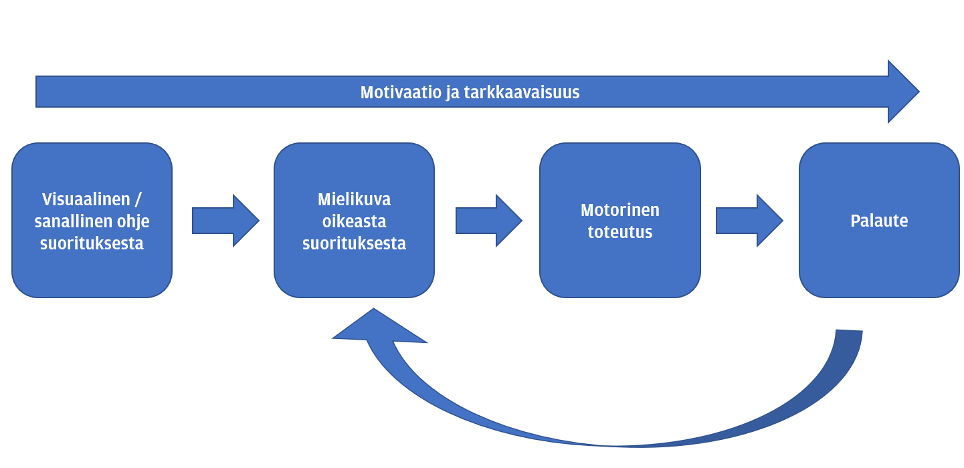
Simplified, the learning process is largely the same, whether it's learning to walk or the technique of a roundhouse kick.

First of all, the learner needs some kind of visual, verbal or a combination of these models of motor performance. A child learning to walk has been watching his parents' recording for a long time, and the motivation to be able to do the same himself is obvious. Movement speeds up considerably, it is easier to reach to grasp things, and parents clearly get excited about companies. An enthusiast practicing the round kick, on the other hand, receives verbal instructions from the coach on the different phases and execution of the kick. Almost without exception, a visual model of the finished kick also follows the narration. The hobbyist's attentiveness and motivation to learn new skills significantly speed up or slow down the learning of the skill. The coach and the operating environment are very decisive in this regard.

Already during the model, an outline of the performance is formed in the learner's mind and the nervous system that controls the movement trajectories in question is activated. When learning new skills, new nerve connections are created in the brain, and at the same time, the entity being learned is linked to something already learned. For example, a spin kick is much the same as a front kick, in which case the nerves created with the already learned skill also help in learning the next skill. The impersonation phase is largely unconscious processing, but directing attention and concentration to the subject to be learned will of course greatly accelerate learning, while a weakening of attention hinders learning. A child learning to walk will fall if the working memory is overloaded, e.g. with stimuli from a nearby TV, just as the performance of a learner of a round kick is disrupted if he thinks about the next drink break during the learning phase.

After the brain and nervous system have been worked on the performance of some kind of model, the learner tries it in practice. Small children are constantly doing experiments on how the body behaves and how, for example, shifting the center of gravity affects balance. Similarly, the learner of the round kick may impatiently try the performance a few times while still being instructed by the coach. The most essential stage of all learning, especially motor skills, is doing it yourself. Learning the roundhouse kick by reading the steps of the technique in a book, for example, is quite challenging, although not impossible. For example, imagery training is based on this. In this case, the actual making phase is left out and the training is based entirely on mental images and creating nerve connections through this.

After the motor performance, the learner receives immediate feedback from his body about the quality of the performance. A small child learning to walk notices the effects when he stumbles and automatically corrects the performance on the next attempt. Similarly, the learner of the spin kick immediately notices how the kick feels and in which direction the foot ends up in the end. A learner in the early stages of learning is not yet able to grasp bodily feedback very well or understand how it affects the quality of performance. Through practice and repetitions, self-reflection skills develop and the learner is more and more able to visualize the entirety of their performance, possible shortcomings and various variations. Feedback on the performance is of course also given by the coach and peers.

The learner combines the feedback in his mind into a new model of the correct performance and the cycle starts over. This is how the skill develops through a cycle formed by repetitions and feedback. The neural connections and the physical characteristics needed to perform the skill develop, making the performance constantly easier and more automatic to repeat. In the initial phase of training the spin kick, the learner still has to focus on each sub-component of the kick separately and a large part of the working memory has to be reserved for the performance itself. On the other hand, an enthusiast who has performed thousands of spin kicks knows the execution almost automatically in different versions and is able to combine it with other learned entities, for example a match movement or part of kick sequences. Top athletes make what they do look effortless and easy, even in fast situations. Performances have been trained to be so automatic and nerve connections so strong that significantly more performance capacity is saved for other functions.

Learning motor skills is most intense in childhood, but even as an adult, you can acquire new skills, albeit more slowly. For this reason, children should practice as versatile as possible various physical skills when the sensitivity season is at its peak.

Learning physical skills is always a social process

Almost all learning is always more or less a social activity, and especially in the early stages of learning, the role of the environment and the teacher is emphasized. Phenomenological learning, problem solving, exploratory learning and task-based learning have been strong trends in the pedagogical discussion in recent decades, and their methods have been applied a lot in physical education and sports. The main idea is that the responsibility for learning is transferred more and more to the learner himself and the learning methods are more and more about doing things instead of passive information transfer. However, it is essential that the learner is not immediately thrown into the deep end without support or tools with which learning can be taught in general. For example. reflecting on different applications of the roundhouse kick in small groups can be a good learning task, but the results will be poor if the actual roundhouse kick practice is still at a stage. Learners are not able to connect the skill they are still practicing with other entities or to understand variability in performance methods.

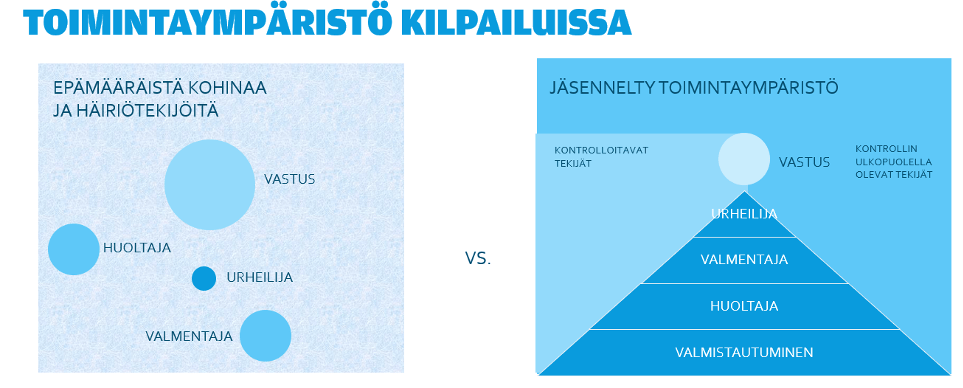
The coach, the learner and the operating environment form a whole, the center of which are the physical skills to be learned.
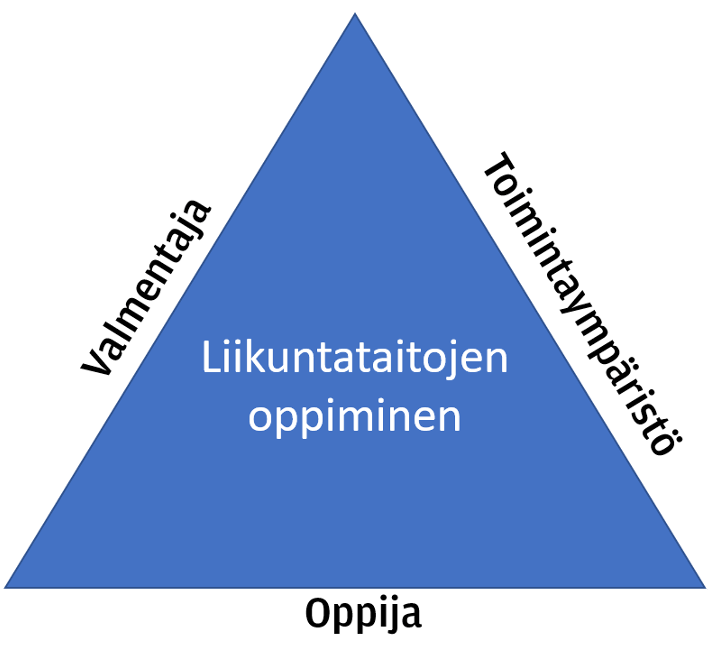
All factors of the triangle have varying degrees of influence in different situations. For example, a young novice hobbyist needs considerably more support from a coach in learning a new skill than an experienced adult hobbyist. Correspondingly, a beginner needs a clear and learning-supportive operating environment, while a conker can do an independent and learning-supportive exercise even at home with the guidance of a coach.

The learner himself affects the outcome of the learning process by directing his attentiveness and concentration to the teaching and the performance itself. Learning is facilitated by an active and curious attitude towards the learned skill and the operating environment. This can be seen, for example, in asking additional questions to the coach and in active communication with training buddies. you can get much more out of the exercise when the learner consciously puts himself in a receptive and open state of mind.

The operating environment includes e.g. training space, training equipment and training buddies. A good space enables versatile exercises and does not in itself limit the coach's toolbox. Good space can also be limited or expanded as needed. The comprehensive training equipment gives more options for the implementation of the exercises and helps in directing the attention and finding the right ways of performing the exercises. For example, a child practicing a spin kick may understand the trajectory of the technique much better when he has a kick target to direct his attention to. Correspondingly, training buddies and peers contribute to the learning of sports skills when everyone has a positive attitude towards the teaching situation and the subject to be learned.

The coach is responsible for planning the exercise and directing the implementation. The above-mentioned learners and the operating environment serve as boundary conditions for the exercise. The core competence of a trainer is the ability to identify the starting level of the learners or the group and plan the exercise so that it serves their learning goals best. The challenge here is of course the individual differences within the training group.

The exercises should be sufficiently challenging, in which case new nerve connections are created and the skills to be learned are linked to larger entities. Too easy and monotonous practice leads to so-called overlearning, i.e. the practice no longer improves marginally and does not increase the ability to apply the skill in new situations. Instead, exercises that are too difficult eat away at learners' motivation when the skill does not seem possible in light of current knowledge. The best results are achieved when easy and difficult exercises are mixed within a single exercise, and not always linearly from easy to difficult. For example, a round kick exercise can be planned so that always after the technique period, the skill of kicking is tried to be applied as part of a more difficult whole, such as a match technique from a movement. After this, we return to the technique phase with a slightly new perspective.

A coach's professionalism also includes knowing the special features of their own sport and the ability to apply different teaching styles to best serve the learning goals.

Special features of taekwondo as exercise and sports hobby

The rules and technical requirements of the sport form the boundary conditions of training and thereby a unique training culture within the sport. At the grassroots level, training cultures can of course vary widely, for example between clubs or coaches who teach in different styles.

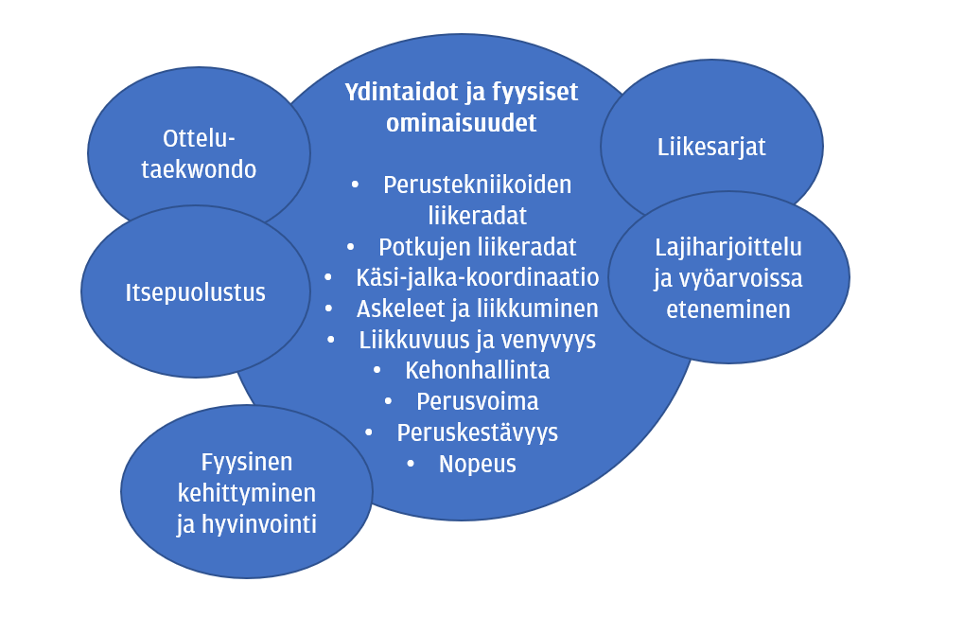
Taekwondo's sport requirements form a very broad and open field of action. Only one club may practice:

  • Basic techniques
  • Business series
  • Kick technique
  • Match Taekwondo
  • Crushing
  • Self defense skills
  • Acrobatics and freestyle moves
  • General physical skills
  • Wide variety of physical properties

Versatility should be seen more as an opportunity than a threat, although sometimes the scope of the sport and the abundance of teaching topics may cause a headache. It is essential to understand that the wide environment provides a basis through which specialization in, for example, competitive matches is implemented. Almost without exception, the best results are achieved through late specialization by providing a varied and stimulating base and emphasizing specialization at a later age. Taekwondo allows late specialization very well. The spectrum of basic skills and physical characteristics to be practiced is so wide that side sports are not needed alongside, although this is not a disadvantage either. Children and young people should be trained in all aspects of the sport and encouraged to compete in both forms of competition, if competing at all motivates the enthusiast. At the junior age, you can already start to shift the emphasis to, for example, more intensive competition training, but on the condition that the basic training has been done with sufficient care.

The whole can be understood by thinking of basic skills and physical characteristics as the center of core training and specialization as part of this whole. The image is an illustration and does not depict the complex entity as such.
Different teaching styles in taekwondo

The teaching style describes the implementation methods chosen by the coach in carrying out the exercise. Roughly different teaching styles can be compared, e.g. based on whether the focus of the activity is the coach, the learner or perhaps the operating environment and social context. The traditional teaching model in both the school and sports worlds has been to favor teacher-led styles, where the role of the coach or teacher is central and the learners are in a relatively passive role of receiver. Taekwondo is no exception in this regard. In a traditional taekwondo exercise, the coach shows the models, gives instructions and then calls out the pace in command style while the learners perform the techniques in unison. In the more applicable parts, the coach defines in advance how the application will be implemented and the trainees try to complete it according to the model.

the good side of coach-oriented teaching styles is that they help the operating environment and the implementation of the exercise to roll in a controlled manner and according to the plan. In addition, the learners receive ready-made models and tools that enable independent completion and application of the skill later on. Because of this, coach-led teaching styles are particularly suitable for teaching elementary groups and children's training groups.

However, a strong coach-led approach has the disadvantage that it does not fully take into account the learners' individual differences, starting levels or self-regulation skills. Faster and more skilled students are not able to move to more challenging performances, while weaker ones may fall off the sled. Correspondingly, the learners' independent thinking and skill-related application ability may remain on a thin foundation, and in the extreme learning and performance of the skill are mainly linked to the coach, instructions and external rhythm. For example, a competitor trained with a command style may find that he is unable to perform a well-practiced solution model in the competition when the context changes from a familiar environment to a different one.

Learner-oriented teaching styles, on the other hand, start from the idea that learners are ultimately always responsible for their own learning and that the most effective way to learn is by experimenting and doing. In learner-oriented teaching, many different tasks and problem solving are used, in which case the learners have to make choices and solutions themselves.

The good side of learner-oriented teaching styles is that they develop creative problem solving and the ability to apply learned skills in very varied situations. The coach also has better opportunities to take the skill level of the group members into account and, if necessary, give more support to those who need it. Those who learn faster, on the other hand, are able to move more efficiently to more challenging tasks.

The biggest challenges, on the other hand, are related to the fact that learners' self-regulation skills or basic knowledge are not necessarily sufficient for working independently with the given goals. In this case, teaching results remain poor and learners have genuine challenges to reach the next level of development independently. It is also significantly more difficult to plan learner-oriented exercises so that the intensity remains hard throughout the exercise. Hard training is not an end in itself, but sometimes, for example, a fighter doing creative situational training also needs training where the pace comes from the outside and the performances are done hard, a lot and they are simple enough.

It is worth remembering that no teaching style is purely coach- or learner-oriented, but actors are always present with different emphases. In terms of teaching styles, it is also not worth looking for the Holy Grail, which would be the one correct way to teach sports skills. The most important thing is to understand the starting level of the group, the differences between individuals and the boundary conditions of the operating environment and shape the exercise based on these. A versatile and self-critical coach is able to test different styles with different groups and find the most optimal ones for different situations. He also remains open to new ideas and is basically ready to take the learners into account, even if the exercise is very teacher-led or command-style. He is also able to offer concrete tools with which to progress in the learned skill to the next level or application phase.

In the following table, the most commonly used teaching styles have been compiled and an example exercise has been given for all of them.

Teaching style

At the center of teaching

Activity and goal

Example exercise

Command-style teaching

Coach

The coach shows and explains the instructions to everyone together. The assignments are usually done at the same time at the teacher's command. The feedback is mainly shared and concerns the entire group. It only takes a little space and is the most effective way to keep the group under control. The learner's role is very small.

In the form of basic technology training. The director shouts the commands.

Task teaching and differentiating teaching

Coach

The coach gives either joint instructions or separate instructions to different small groups, after which the assigned task is practiced at one's own pace. The coach gives feedback to both the group and individuals. Tasks can be effectively differentiated with exercise equipment. The trainer can assign different difficulty levels and progressions to the tasks.

Situational training in match training. Let's practice a prepared situation where A kicks with the back foot and B does a back kick in response. We take turns at our own pace. The coach goes around giving feedback and additional instructions.

Teaching based on self-assessment

Learner

The coach gives the task, but the learner's task is to independently evaluate his performance. The coach must give clear instructions on the evaluation criteria so that the learner has enough tools to correct his own performance. The coach can still be involved in giving feedback.

Complete sets of movements are practiced so that the coach always gives an instruction between the exercises, what to pay attention to. Learners evaluate their own performance and do it at their own pace.

Guided insight and problem solving

Learner

The coach gives the students a problem or a task, but not a direct solution to it. Most of the time there are many solutions and the learner has to think about the implementation method himself. The coach can guide insight with help questions and tips if necessary. The tools can effectively limit problems.

Situational training in match training. The coach assigns A the task of attacking only with front leg spin kicks, and B must develop different defensive solutions for this.

Teaching based on creativity

Learner

The coach gives a task where the learners have to develop something new independently or in small groups based on the skills they have already learned. The coach gives the framework for the task, but otherwise the work is free and the emphasis is on the creative application of learned things and the development of new ones.

The children's group is divided into small groups. The groups independently develop a short taekwondo performance. The task can be limited to certain elements or you can freely develop the display according to your own taste.

Pair or group guidance

Learners together

The coach gives the task or its main features, after which it is practiced in pairs or groups so that others are constantly given feedback and the learners are each other's peer teachers. The exercise can also be based on making the students themselves teachers.

Movement series training in pairs or small groups. One performs the performance and the others give feedback either according to the coach's instructions or independently.

Teaching by example (coach included)

Coach and learner

The coach gives a task, after which you do it yourself in pairs or in small groups. The coach must be able to achieve the performances that are hoped to be achieved with the learners. The feedback is very individual, but it is difficult to monitor the activities of the entire group.

Circuit sparring, where the coach is involved in doing it himself. He always gives individual feedback to whoever he is paired with.

It is therefore worth testing different styles in your own coaching work and honestly evaluating their impact on learning. Even within a single exercise, you can vary from one style to another, and often this is the most effective way to learn something new and apply what you have already learned.

Categories
front page Slider Newsletter General

Situation overview of taekwondo athletes 20.4.

Situation overview of taekwondo athletes 20.4.

Hello everyone!

I hope the restrictions don't start to taste like cardboard already. It would be really fun to get back to a normal training routine, but you have to be patient. However, it has been nice to notice how positively enthusiasts have received the live classes that started last week. There have been enough participants in both children's and adults' training sessions. If you didn't participate last week, roll up your sleeves and join us for training! Also remember to watch the virtual lessons if you haven't done so yet.

Content of the situation review:

  • This week's live workouts
  • Crisis period campaigns valid for a few more weeks
  • Coaching blog, podcasts and other interesting content

This week's live workouts

This week you can e.g. to train together with the child. For example, for those who train in family groups or groups of small children, this is a great opportunity to train together with a parent.

You can find live lessons and links to participate:

https://tu11.fi/taekwondo/live/

The password for the website has been sent to all enthusiasts by e-mail. Let me know if you haven't received the password.

You don't need to register for the live classes in advance, it's enough to participate via the website. The link guides you to the implementation of the Zoom service, no matter what your device is. To participate, you need a smart device with a camera, such as a computer, mobile phone or tablet. You can also participate without your own video, but in that case the instructor will not be able to give you feedback.

Live! - website you can also find past video lessons, which means that the training is successful, even if you don't have enough time at the actual time.

Please remember that you can collect training notes for the belt tests from all the video workouts and live workouts you complete. Younger enthusiasts must get their parents' signature for the completed training. Return your training entries to the gym after opening.

Live training schedule:

Tue 21.4. 17:00-17:45 – Children (under 12)
Tue 21.4. 18:00-19:00 – Youth and adults + competition groups (Over 12 years old)

Wed 22.4. 17:00-17:45 – Taekwondo for a child and a parent (suitable for a child aged around 4-9 and a parent. The exercise is done together with the child.)
Wed 22.4. 18:00-18:30 – Stretching (All enthusiasts)

Thu 23.4. 17:00-17:45 – Children (under 12)
Thu 23.4. 18:00-19:00 – Youth and adults + competition groups (Over 12 years old)

The age divisions are indicative.

So you can join our website's Live! from the section.

Crisis period campaigns valid for a few more weeks

  • By paying for your next contract period (3 months) by the end of April, you will receive one additional month of exercises free of charge
  • By paying for two contract seasons at once (6 months), we add two extra months to the training contract

The campaigns automatically apply to all new 3-month payment periods that start in March or April. If your payment period does not start until after this time, you can take advantage of the campaign by paying for your training period in advance. You must also notify us separately if you want to take the 6-month offer instead of the 3-month one.

In addition to this, we offer those who have paid:

  • Virtual workouts of the growing library
  • Live training several times a week
  • A self-paced exercise program
  • Possibility to borrow the club's fire mats for your own home training
  • Free camps as soon as the hall is opened
  • No summer break this year, but the exercises will continue without a break throughout the summer, if the situation allows
  • Update or additional services for all contract types:
    • Basic agreement for adults -> A month's training right for the weight room
    • Basic contract for children -> One month training right for the children's competition team
    • Adult athlete contract -> One month's training right at the weight room. Private lesson for those who already have a contract for the gym.
    • Children's athlete contract -> Free private lesson or lesson with a couple, depending on the age of the enthusiast.

Thank you to everyone for your support and understanding in a difficult situation when we are unable to offer full service.

Please tell us what else we could offer you while the hall is closed? We implement the suggestions if at all possible. The best suggestions will be rewarded with a surprise prize!

Coaching blog, Podcasts, Kick.AI and other interesting content

In addition to physical training, it is always appropriate to expand one's knowledge of the sport and perspectives on one's own training.

The Taekwondo athletes' coaching blog offers strict things to support coaching and sports:

https://tu11.fi/taekwondo/valmennusblogi/

Go listen to the coaches' introductions on the Taekwondo athletes' Podcasts. The series starts with Teemu's story and more is coming.

https://tu11.fi/taekwondo/podcastit/

Check out Kick.AI's kick sensor on the company's website. Kick:AI supports Taekwondo athletes for every sensor sold. Order yours with the code CLUBAIDTU11. Kick.AI also promised to hold an introductory demo separately, if there are enough people interested. Sign up by sending us an email. Check out Kick.AI on their website:

https://www.kickai.com/

The network is full of varying levels of content from the world of taekwondo and sports. We have collected the materials in one place:

https://tu11.fi/taekwondo/2020/04/linkkeja/


Categories
Coaching blog

Why is competing exciting and how can the excitement be alleviated?

What actually causes the competitive tension?

Excitement is certainly a familiar feeling for every athlete, and almost everyone will certainly agree that exasperation does not feel very pleasant. Experiencing excitement and especially reactions and ways of acting vary greatly between individuals. Others are in an overloaded state, unable to stay still for a moment while the other goes limp and the muscles feel heavy. However, it is good to remember that tension is also a good thing for performance, and it is precisely through the tension reaction that the body optimally prepares for performance.

Excitement is a completely natural reaction to a perceived threatening situation. Tension is triggered by a stress reaction, which in turn arises from the fact that we subconsciously interpret that we are in a threatening or dangerous situation. This defense reaction is older than our species and has also been a key survival mechanism for most of modern man's time on earth.

Usually, when examining the phenomenon, we talk about the body's automaticity fight or flight -reaction, the task of which is to automatically and quickly prepare the body for a situation where we have to work at the limits of our abilities. Quick action, for example when a tiger is lurking in a nearby bush, has helped our species survive harsh conditions where dangers are commonplace. Today, we don't have to fear spontaneous attacks from tigers, but our reaction to perceived threatening situations is completely identical to our ancestors.

The stress reaction triggers a spike in cortisol and adrenaline in the body, which in turn direct the nervous system to focus all of our essential resources on activities that help survival. This means, for example, an increase in blood circulation around large muscles and in the areas that control reactivity and perception of the brain. Our heart rate increases, our blood pressure rises and our breathing becomes more rapid. On the other hand, functions secondary to survival, such as digestion or areas that control the more analytical parts of the brain, slow down. Because of this, e.g. on race days, the stomach is often a bit upset and the food doesn't taste good. The thought also doesn't really want to run, which is often reflected in the fact that we forget things and entities during competition performance that we control well in indoor conditions. They just aren't ingrained enough to be automatic functions.

The tension in the races is therefore caused by the fact that you subconsciously interpret the situation as threatening, even though you rationally understand that nothing terrible can happen. However, the reaction is so automatic that you can't just force your body not to tense up, and there's no reason to. As said, the right amount of tension improves the level of performance.

The intensity of tension is especially affected by how we handle the situation and what kind of thought chains it generates. With the help of these, we can also learn to regulate the amount of our tension through training and thereby optimize our competitive mood.

How much is an appropriate amount of tension?

In a stress reaction and state of tension, our body prepares for the performance and competition situation, and trying to get rid of all tension would be a bad solution when thinking about the competition performance. The essential thing is to find the means that suit you, with which you can regulate the amount of tension and feeling so that when the competition comes, you can perform at your best.

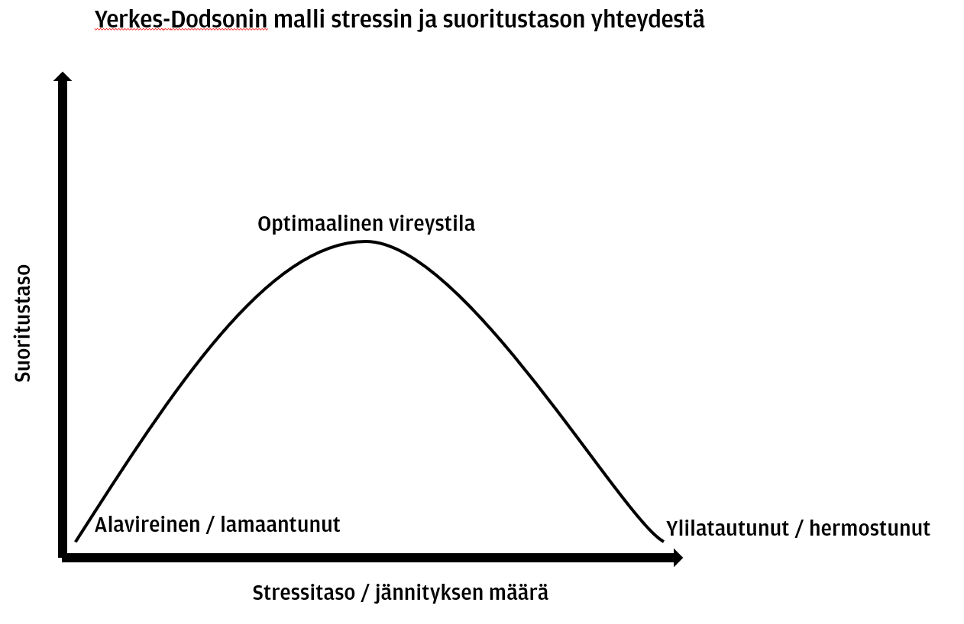
The Yerkes-Dodson law describes the connection between the state of stress and the level of performance and was developed already at the beginning of the 20th century by psychologists Robert Yerkes and John Dodson. The model is, of course, a simplification of complex processes, but it has stood the test of time and also illustrates well how to find the optimal state of alertness needed for sports performance.

It is good for the athlete to learn to observe and understand where his stress level usually settles on the day of the competition and what kind of feelings and thought chains arise from it.

For some, the stress level and the amount of tension grow so big that they start to hinder performance. This can be seen as restlessness and difficulty concentrating on things that are essential for performance. Athletes often try to relieve tension with familiar emotion regulation methods. One immerses himself in listening to music that helps the body and mind to calm down, while the other has a compulsive need to warm up all the time and keep the body moving.

For others, the rise in stress levels causes the opposite reaction, i.e. the body starts to feel heavy and depressed. The body goes into an economizing flame, as it were, and lowers the stress level mechanically if it is not able to do so at the level of thoughts. In this case, the athlete should find ways to raise the state of alertness, for example by means of a sharp warm-up.

Learn to recognize your own stress reactions

When it comes to regulating tension, it is essential to first learn to recognize your own standard reactions to a situation perceived as stressful. It's worth starting by considering how tension changes your actions on a mental level, as bodily reactions or changes in behavior.

Mental level (cognitive changes)
  • Thought chains - what kind of thought chains does excitement create in you. for example, do you go over and over the possible outcomes or mistakes you might make. Do you think a lot about what others think about your performance or result?
  • Emotional states - What kind of emotional states does race day and race performance cause in you. For example, do you feel scared or maybe excited?
  • Attention and ability to concentrate - Can you focus on things that are essential for performance. Where is your attention directed and what kinds of things do you notice in particular?
  • Self-talk - What is your self-talk like on race day? Do you repeat positive sentences to yourself in your mind that help you perform, or is your self-talk more discouraging and preparing yourself for failure in advance?
Bodily reactions (somatic changes)
  • Sensations in the muscles - Do your muscles feel stiff and heavy or do you feel light and fast?
  • Increased heart rate and breathing - Monitor your breathing and heart rate
  • Butterflies in the stomach – A feeling of pressure in the lower abdomen and perhaps an increased need to go to the bathroom.
Changes in behavior
  • Posture and gaze - Does your posture change when you tense up? Do your shoulders slump or do you look down at the floor?
  • Activity Rate – Does stress increase or decrease your activity? Do you feel like you should be doing something all the time or rather that it would be nice to curl up for a nap?
  • Introversion and extroversion – Do you have more or less contact with other people on race day? For others, the support of a group can be important when they are tense, where the other would like to be more at peace.

So many changes take place in the mind and body of the athlete as they prepare for the performance. Some are easier to notice than others, and the whole they form is unique to each athlete. Recognizing your own stress reactions is a useful skill, because only through them can we regulate our overall mood through training.

How do I regulate my own state of alertness?

It would be nice if we could click our fingers to put our bodies in the perfect state of tune for performance. However, this magic trick is not possible, and even top-level professionals have to constantly practice adjusting their tuning. Peaks are also exciting, even if it doesn't always seem so from the outside. However, through experience and purposeful training, they have learned to utilize their stress reaction as part of preparing for competition performance.

Next, we will introduce ways in which you can regulate your level of alertness and tension, but as said, purposeful training of these even outside of competition is the only way to make them part of your toolbox.

Train and compete a lot and a little more

This instruction is pretty self-explanatory. By doing something repeatedly in large quantities, it develops into a routine, and routines are easy to perform, no matter what the state of alertness. It is clear that someone who goes to 40 competitions a year feels the competition situation much more familiar than someone who goes to six competitions. Similarly, self-confidence in competitions is born above all from the feeling that you have trained hard and done everything you can in the gym.

Learn to recognize and name your feelings during the race day

As mentioned earlier, recognizing our own sensations and bodily changes is necessary if we want to regulate them. Naming sensations (labelling) is already a strong tool for self-regulation. The mere fact that we are able to tell ourselves honestly that we are tense at the moment and it feels like this and that helps us to get rid of all the chains of thought and judgments that we automatically attach to the situation.

One effective way to relieve tension is to redefine the sensations it causes as excitement. Physically, these sensations are almost identical, so through self-talk we can, as it were, "trick" ourselves into feeling enthusiasm instead of tension.

Learn to turn negative thought chains and self-talk into positive ones

No matter what our external situation is, our mind tries to structure it in some way in an understandable and controllable form. When a tiger attacks from the mouth, we don't have time for long chains of thought, so we act purely through the stress reaction and automatic functions. However, in a prolonged stressful situation, for example when waiting for our own performance, we have time to reflect on the situation.

However, our thought processes are often unreasonably negative, as is our self-talk. In a threatening situation, our mind prepares for the worst possible outcome, so that it would be easier to accept it in time. However, negative thought chains hinder the competition performance itself and take our attention to things that are beyond our control. In addition, focusing on the negative, e.g. avoiding mistakes, will almost certainly lead to exactly this mistake. For example, if you shout to the opponent in the middle of the match not to look at the scoreboard, he will almost certainly immediately turn his eyes there.

To break negative thought chains, it is enough to be able to recognize them (when they appear) and accept them as they are. In this case, their power ceases automatically. It is also worth learning a few positive self-talk patterns, which are repeated like a mantra, e.g. right before the performance:

"I have practiced hard and I can do this"
"I feel strong" (even though it doesn't feel like it)
"The first thing I do in my performance is..."
"I have prepared sufficiently. We'll see how long it takes this time"
"The only thing I can influence is my own performance"

Focus on things you can influence

Every extra thing that the athlete pays attention to during the competition day is taken away from the resources that he could use for things that are essential for performance. For example, a movement series athlete preparing for his own performance has no reason to intensely watch the performance of his opponents, because they simply cannot be influenced. At worst, they only increase our own anxiety if we evaluate the opponent's performance as good. Correspondingly, when a competitor focuses his attention solely on the characteristics and skills of his opponent, his own performance suffers.

The athlete should develop a basic routine that suits him from race to race, consisting of things that are controllable and not dependent on changing external factors. There will certainly be changes and surprising situations in every competition, but a good basic routine takes these into account. These include, for example, eating on race day, planned warm-up and finishing just before the performance.

Mental preparation:

Almost all top athletes prepare for competition in one way or another, also psychologically. At the very least, you should go through the competition situation in your mind as a process a few times before the event itself. Imagine the whole day in your mind as visually and step-rich as possible. What kind of competition venue is it, how do you warm up, what do you eat at any point, what kind of sensations do you get during the day, how do you feel right before the performance, etc. In this way, it is possible to collect a "competition routine" even when we are not in competitions. Going through the situation intensively in the mind triggers the same mechanisms in our body as the situation itself.

Mental preparation can also be taken much further by making imagery training a regular part of your training routine. In this case, the athlete practices the control of the body's self-regulation mechanisms in advance, and ready-made routines can be created, which can be used to tune in to the optimal state in the blink of an eye before the competition performance. However, you should start practicing these with the guidance of a competent trainer.

Correspondingly, different breathing techniques and mindfulness -exercises regularly gives you new tools for managing bodily and mental sensations.

Something to remember

  • Tension is a completely natural reaction to a perceived threat, and the right amount of tension improves performance.
  • Learn to recognize how tension affects you mentally, physically and at the level of behavioral changes.
  • Develop routines for yourself that you can repeat from competition to competition, even if external factors change.
  • Train and compete hard to build up your routine.
Categories
front page Slider Newsletter General

Situation overview of taekwondo athletes 13.4.

Situation overview of taekwondo athletes 13.4.

Have a nice start to the week everyone!

There have been no significant changes to the corona situation and compliance with caution and restriction measures is still of primary importance in all activities. We constantly monitor the guidelines and regulations regarding the opening hours of schools, restrictions on gatherings, and physical activities.

It has been nice to notice that many enthusiasts are excited to do video workouts, and in addition, the first live lessons were also held last week. We will keep more of these weekly in the future.

Content of the situation review

  • Live lessons available every week when the gym is closed!
  • This week's live workouts
  • A reminder of our offer and promotions while the gym is closed

Live classes available every week

In addition to video workouts, we started organizing online live classes last week. The trial lessons went really well and a large group of enthusiasts participated in the training. In the future, we will always inform you about the next week's live training in this situation review, as well as on our website's Live! - section:

https://tu11.fi/taekwondo/live/

The password for the pages is the same as for the virtual lessons and was delivered to all enthusiasts by email. Please contact us if you haven't received yours yet.

You don't need to register for live lessons in advance, it's enough to participate via the website. The link guides you to the implementation of the Zoom service, no matter what your device is. To participate, you need a smart device with a camera, such as a computer, mobile phone or tablet. You can also participate without your own video, but in that case the instructor will not be able to give you feedback.

Live! - website you can also find past video lessons, which means that the training is successful, even if you don't have enough time at the actual time.

Participating in live classes is very easy, but feel free to ask if you have any problems with the technology.

Please remember that you can collect training notes for the belt tests from all the video workouts and live workouts you complete. Younger enthusiasts must get their parents' signature for the completed training. Return your training entries to the gym after opening.

This week's live workouts

Tue 14.4. 17:00-17:45 – Children (under 12)
Tue 14.4. 18:00-19:00 – Youth and adults + competition groups (Over 12 years old)

Wed 15.4. 17:00-18:00 – Fitness circuit and stretching (over 12 years old)

Thu 16.4. 17:00-17:45 – Children (under 12)
Thu16.4. 18:00-19:00 – Youth and adults + competition groups (Over 12 years old)

The age divisions are indicative.

So you can join our website's Live! from the section

A reminder of our offer and promotions while the gym is closed

  • By paying for your next contract period (3 months) by the end of April, you will receive one additional month of exercises free of charge
  • By paying for two contract seasons at once (6 months), we add two extra months to the training contract

The campaigns automatically apply to all new 3-month payment periods that start in March or April. If your payment period does not start until after this time, you can take advantage of the campaign by paying for your training period in advance. You must also notify us separately if you want to take the 6-month offer instead of the 3-month one.

In addition to this, we offer those who have paid:

  • Virtual classes
  • Live workouts
  • A self-paced exercise program
  • Free camps as soon as the hall is opened
  • No summer break this year, but the exercises will continue without a break throughout the summer, if the situation allows
  • Update or additional services for all contract types:
    • Basic agreement for adults -> A month's training right for the weight room
    • Basic contract for children -> One month training right for the children's competition team
    • Adult athlete contract -> One month's training right at the weight room. Private lesson for those who already have a contract for the gym.
    • Children's athlete contract -> Free private lesson or lesson with a couple, depending on the age of the enthusiast.

Thank you to everyone for your support and understanding in a difficult situation when we are unable to provide full service.

Please tell us what else we could offer you while the hall is closed? We implement the suggestions if at all possible. The best suggestions will be rewarded with a surprise prize!


Categories
front page Slider Newsletter General

Situation overview of taekwondo athletes 7.4.

Content of the situation review

  • The gym will have to be closed at least until the beginning of May
  • Collect training marks for belt exams from home workouts too!
  • The first live trainings online will take place this week
  • Make your own video or social media update about home workouts!
  • Go listen to Taekwondo athletes' first podcast
  • Do you need taekwondo mats for home training?

The hall continues to be closed

The restrictive measures have significantly slowed down the spread of the coronavirus in Finland, but it is worth remembering that the peak of the disease is still ahead. Of course, we would very much like to be able to train again in the usual way, but first we have to make sure that the epidemic wave is starting to subside. We closely follow the authorities' recommendations and instructions, and based on these, the hall will be closed at least until the beginning of May, following the gathering restrictions and other recommendations. We will continue to inform you every week about the development of the situation.

Our campaign to keep the club's financial situation stable is still ongoing. With the help of the campaign, we hope to be able to keep the club's cash situation at a level that the operation can be continued even after the epidemic subsides. Some of the enthusiasts have already taken part in the campaign, but every training fee paid enables the development and continuation of activities even in times of crisis. A big thank you to everyone who is involved in supporting the club!

A reminder of the benefits we offer to all enthusiasts who continue their contract:

  • By paying for your next contract period (3 months) by the end of April, you will receive one additional month of exercises free of charge
  • By paying for two contract seasons at once (6 months), we add two extra months to the training contract

The campaigns automatically apply to all new 3-month payment periods that start in March or April. If your payment period does not start until after this time, you can take advantage of the campaign by paying for your training period in advance. You must also notify us separately if you want to take the 6-month offer instead of the 3-month one.

In addition to this, we offer those who have paid:

  • Virtual classes and live trainings starting soon online when the gym is closed
  • A self-paced exercise program
  • Free camps as soon as the hall is opened
  • No summer break this year, but the exercises will continue without a break throughout the summer, if the situation allows
  • Update or additional services for all contract types:
    • Basic agreement for adults -> A month's training right for the weight room
    • Basic contract for children -> One month training right for the children's competition team
    • Adult athlete contract -> One month's training right at the weight room. Private lesson for those who already have a contract for the gym.
    • Children's athlete contract -> Free private lesson or lesson with a couple, depending on the age of the enthusiast.

Thank you to everyone for your support and understanding in a difficult situation when we are unable to offer full service.

Please tell us what else we could offer you while the hall is closed? We implement the suggestions if at all possible. The best suggestions will be rewarded with a surprise prize!

Collect training marks for belt exams from home workouts too!

More video lessons are still being actively recorded, and if someone hasn't found them yet, the address was:

https://tu11.fi/taekwondo/virtuaalitunnit/

Palvelun salasana on lähetetty kaikille harrastajille sähköpostitse. Jos et ole vielä saanut omaasi, ota yhteyttä info@tu11.fi

There are video lessons everywhere, and new ones are constantly being made. We recommend trying different forms of training and applying exercises according to your own preferences. On the website you will also find a program for independent home exercise. The instruction in question contains plenty of different exercises with complete instructions.

Home exercisers are also allowed to collect training marks for belt tests, just like when training at the gym. In order to earn a training label, the enthusiast must do at least half an hour of self-paced sport training or specialty training at home, with or without video guidance. Workouts are marked on a free-form list and parents' signatures are taken for each workout. Enthusiasts over the age of 16 do not need to get a parent's signature. :D

The first live trainings online will take place already this week

The technology for live broadcasts does not yet work as expected, but we will hold the first live broadcast as a test already this week. You can participate in the training with a computer, mobile phone or smart device with a camera. This is how the coach sees you and you see the coach. The class is designed in such a way that it can be done even in a small space at home.

The first live workout is shared by everyone, but in the future we will target our own workouts for different age groups and skill groups.

We send all enthusiasts a separate invitation to the training by e-mail. The training is carried out via the Zoom service, and the email provides more detailed instructions on how to join the training. It's not difficult.

Make your own video or social media update about home workouts

Post pictures or training videos of your home workouts on social media using #tu11 #taekwondo #tu11home workouts #tu11coronafight hashtags. Also take part in the home workout challenge and see how long you can do a workout tube. In the challenge, the training streak is maintained when you post a photo or video of your own home workouts every day (1 rest day per week is allowed.) The person who completes the longest training streak will be rewarded with a surprise prize!

You can also send us your picture or video if you want us to publish it on the club's own social media channels. For example, members of the competition team can compile a few minutes of training tips for other enthusiasts.

Go listen to Taekwondo athletes' first Podcast episode

In order to cheer up our enthusiasts, we decided to start a Podcast series that introduces coaches and their sports backgrounds. In the first episode, Teemu talks about the early stages of his career. More Teemu's story and other coaches' introductions coming soon. You can listen to the story:

https://tu11.fi/taekwondo/2020/04/teemu-heino-1/

You can also find the podcast on Spotify by typing Taekwondo athletes 2011 in the search.

Do you need taekwondo mats for home training? I have mats to borrow from the gym for the duration of the stay. 

There is currently no active training in the gym, so the club's fire mats are also lying on the floor as unnecessary. Would you like to give the carpets a good home for a while, when they too can fulfill their purpose. The offer applies to all those who have paid their training fees without a break. Taekwondo athletes can request the mats back at any time with 3 days' notice, and the athlete is of course responsible for the condition of the mats during the loan period. The carpets must be picked up and returned by yourself. Ask for more information info@tu11.fi. We will give more detailed instructions to those interested in the matter.

Completely unused fire mats are also on sale for €30/pc.


Categories
front page Slider Newsletter General

Situation overview of taekwondo athletes on 30 March 2020

Content of the situation review

  • Taekwondo athletes are busy developing club activities even better, since physical training will be successful again
  • More virtual exercises are constantly being produced. By training together, you can collect training marks for the belt tests
  • We will start the live classes broadcast via the network as soon as possible
  • The self-paced training program of the competition groups is constantly updated
  • A big thank you to everyone who took advantage of the offers and benefits during this difficult time.

What do Taekwondo athletes do when the gym is closed?

The hall's doors have been closed for a couple of weeks now, and it is still impossible to predict the opening at this point. We are still monitoring the effects of the corona epidemic and the Government's recommendations in this regard on a daily basis. Of course, the most important thing is the safety of enthusiasts, instructors and their close circle.

In spite of everything, the club members have not rested on their laurels, but the development of operations and quality improvement have started to be implemented in a big way now that day-to-day operations cannot be carried out. We want to make sure that when the hall opens again, the activities can be started from the same, if not better, starting points than when the break started. Correspondingly, we have worked hard on the video workouts and scrubbed the gym down to the last corner, so that the enthusiasts can get to a clean and well-ordered training space as soon as the workouts start again.

More video lessons are constantly being produced - by training along, you can collect training notes!

We shoot and produce new video workouts constantly, and if you haven't done them yet, I'll send you to the address:

https://tu11.fi/taekwondo/virtuaalitunnit/

The password has been sent to all enthusiasts by e-mail. If you haven't received yours yet, please contact us info@tu11.fi.

The video lessons are intended for our entire group of enthusiasts, and there is sure to be something suitable for everyone. There are also feature exercises, and all the workouts are designed so that they can be done at home even in a small space.

Home exercisers are also allowed to collect training marks for belt tests, just like when training at the gym. In order to earn a training label, the enthusiast must do at least half an hour of self-paced sport training or specialty training at home, with or without video guidance. Workouts are marked on a free-form list and parents' signatures are taken for each workout. Enthusiasts over the age of 16 do not need to get a parent's signature. :D

Post pictures or training videos of your home workouts on social media using #tu11 #taekwondo #tu11home workouts #tu11coronafight hashtags. Also take part in the home workout challenge and see how long you can do a workout tube. In the challenge, the training streak is maintained when you post a photo or video of your own home workouts every day (1 rest day per week is allowed.) The person who completes the longest training streak will be rewarded with a surprise prize!

Live workouts online will start as soon as possible

The good thing about the virtual lessons recorded on our website is that you can watch them according to your own schedule when it suits you best. However, a joint guided exercise has its own charm, even if there is a bit space between physically. Modern technology makes it possible to hold live exercises over the network, and we are going to develop and implement this idea as soon as possible. We hope to start the live broadcasts already next week, as long as we get the technology right first. We will announce the time of live training separately.

The self-paced training program of those training in competition groups is constantly updated

The members of the competition group have been sent a self-paced training program, the main focus of which is developing basic fitness. We are constantly updating this plan and sending updated versions to group members. There is also a sample weekly program to follow.

Other enthusiasts can also follow the program in question or get training tips from it. You can find the program at the same address as our video lessons.

A big thank you to the enthusiasts who took the offers and paid the training fees!

We published a campaign a couple of weeks ago, with the help of which we hope to keep the club's cash situation at a level that operations can be continued even after the epidemic subsides. Enthusiasts have seized the offers in impressive numbers. Big thanks to you! A reminder of the benefits we offer to all enthusiasts who continue their contract:

  • By paying for your next contract period (3 months) by the end of April, you will receive one additional month of exercises free of charge
  • By paying for two contract seasons at once (6 months), we add two extra months to the training contract

The campaigns automatically apply to all new 3-month payment periods that start in March or April. If your payment period does not start until after this time, you can take advantage of the campaign by paying for your training period in advance. Please also inform us separately if you want to take the 6-month offer instead of the 3-month one. In addition to this, we offer those who have paid:

  • Virtual classes and live training will start soon when the gym is closed
  • Training programs for competition groups
  • Free camps as soon as the hall is opened
  • No summer break this year, but the exercises will continue without a break throughout the summer, if the situation allows
  • Update or additional services for all contract types:
    • Basic agreement for adults -> A month's training right for the weight room
    • Basic contract for children -> One month training right for the children's competition team
    • Adult athlete contract -> One month's training right at the weight room. Private lesson for those who already have a contract for the gym.
    • Children's athlete contract -> Free private lesson or lesson with a couple, depending on the age of the enthusiast.

What else can we offer you now that the hall is closed?

Do you have an idea what the club could offer you enthusiasts now that the gym is closed? Tell us your idea and we will make it happen if at all possible. We reward those who sent the best ideas with club-themed products!

Cheers and good home workouts to everyone!


Categories
front page Slider Newsletter General

Training during and after the gym is closed

Taekwondo | Helsinki

We offer lessons even when the hall is closed!

Taekwondo athletes wants to offer its members training opportunities even when the gym is closed. Accordingly, we will comprehensively organize additional activities to make up for the lost training time as soon as we can start normal group training again.

Please read this news carefully as it contains a lot of information and valuable benefits in this exceptional situation.

Taekwondo athletes offers virtual lessons when the gym is closed

Virtual classes offer activities when the hall doors are closed. There is a wide range of things on offer, from side exercises to sports training.

You can watch it here from the link>> or by clicking the menu in the upper right corner of the page.

All those who have paid the training fee have received a password with the newsletter. If you have not received your password, please contact us info@tu11.fi.

Training of competition teams

Enthusiasts of competition groups receive a separate training program, which allows you to carry out characteristic training even at home.

Athletes preparing for value competitions receive separate instructions on training when the gym is closed.

Support the club's activities in a difficult situation and pay your future training fee in advance. In exchange, we offer training time in your contract!

The mild economic effects of the epidemic are difficult for many parties, including Taekwondo athletes. Vakka operations will be reduced to a minimum, the club's fixed expenses, such as rent and salaries, will remain as before. As the situation drags on, the continuity of the club is at stake. Because of this, we appeal to everyone, for whom it is at all possible, to continue your training contract and help the club through this difficult situation. To encourage this, we have decided to launch the following campaign:

  • By paying for your next contract period (3 months) by the end of April, you will receive one additional month of exercises free of charge
  • By paying for two contract seasons at once (6 months), we add two extra months to the training contract

The campaigns automatically apply to all new 3-month payment periods that start in March or April. If your payment period does not start until after this time, you can take advantage of the campaign by paying for your training period in advance. You must also notify us separately if you want to take the 6-month offer instead of the 3-month one.

Training when the gym opens again

We will return to the normal schedule as soon as it is possible and, above all, safe. We follow the regulations and recommendations of the authorities, and it may be that the training has to be applied in the beginning, e.g. by emphasizing individual exercises or limiting group sizes.

However, we want to think in advance of ways in which we can thank enthusiasts who have paid their training fees even when we have not been able to offer a full service.

Additional camps

We organize a few extra camps free of charge for all enthusiasts who have paid the training fee without interruption.

No summer break this year

This summer, we will train throughout the summer, if the situation only allows it at that point. Normally, we have kept the doors of the gym closed for a few weeks in July, but this summer we will continue training even beyond this time. Exercises are therefore offered throughout the summer for all age groups

Additional services for all contracts

We offer tangible benefits to all those who have paid their training fee without interruption in their contract

  • Basic agreement for adults -> A month's training right for the weight room
  • Basic contract for children -> One month training right for the children's competition team
  • Adult athlete contract -> One month's training right at the weight room. Private lesson for those who already have a contract for the gym.
  • Children's athlete contract -> Free private lesson or lesson with a couple, depending on the age of the enthusiast.

The March belt exams will be held as soon as possible

The belt exams in March will have to be postponed to the future. Invoices have already been sent for the belt tests, so you register for the test as usual by paying this invoice now. The belt test will be organized as soon as normal training activities can be started again. We will send more detailed information about the tests to the participants as soon as we can confirm the dates.

Please let us know soon if you are not going to participate in the exam and we will refund the invoice.

Thank you for your support and understanding during this challenging time.

Categories
front page Slider Newsletter General

Information for taekwondo athletes regarding covid-19 (March 13, 2020)

The coronavirus is raging around the world and Finland is on the brink of an epidemic. The situation is alive every day, and a lot is already happening in a few days. Taekwondo athletes 2011 ry recognizes its own role in preventing and possibly limiting the epidemic and feels its responsibility in this matter. The board of the club has been meeting all week and at today's meeting we made the decision to calm the situation for the weekend and use the weekend time to monitor the development of the situation and make the best possible decisions for the benefit of our fans.

Practices on Friday evening (13.3.2020) will be held as usual, but for the weekend, all activities at the gym are suspended. The suspension includes practices according to the calendar on Saturday (March 14) and Sunday (March 15), including family groups, as well as Saturday's crushing camp. For family groups, replacement exercises will be organized at a later date. Likewise, a new date for the crushing camp will be sought as soon as the situation permits.

Taekwondo athletes will make decisions about next week's activities and measures on Sunday evening. On Monday morning, March 16, 2020, there will be a new member information about the activities of the week that started at that time. We regret that we cannot guarantee normal activity in the coming weeks, but we strive to guarantee the safest possible training conditions for enthusiasts in this difficult situation. In terms of the continuity of club activities, the support of the entire TU11 community is now especially important!

On Friday, when you possibly go to the gym, remember to be especially careful with washing your hands. Everyone washes their hands with soap before the exercises. Pair exercises and all close contact with other trainees have also been removed from Friday's exercises. Despite the difficult conditions, have a nice weekend!

- The board of the Taekwondo athletes 2011 association

Please remember:

  • Wash your hands regularly and thoroughly with soap.
  • Avoid unnecessary close contact, for example during training or when you are in the gym. Any exercises during the epidemic are planned so that no contact is made.
  • If you feel even a little sore, skip the workout and stay home.
  • Actively follows the club's and authorities' news and related instructions.

More information:

info@tu11.fi
0451827290