Categories
Coaching blog

Thoughts on the ethics of sport

At our taekwondo hall in Konala, a large number of young athletes train, whose achievements in training and competitions I have watched not only from the point of view of physical performance, but also from the point of view of these young people's enthusiasm, passion and attitude to victory and defeat. While following the young players of my own club, I have occasionally had various ideas about the development of this athlete's personality, or the mental side - if you want to say it - of guiding the development of this athlete's personality, which are not structured and somewhat unstructured, but intertwined with the same theme. It wasn't on my active mind when I went for a ski run one evening and put the earbuds in my ears.

After the opening music that sets the mood Jari Sarasvuo started talking to me. First, as a warm-up, some soft spring nuggets and SAK's manna, but Sarasvuo's story warmed up as quickly as the skier Petiko in the first ascents of Vitonen and progressed to a topic that was meaningful to me. On 7 March 2016, Jari Sarasvuo spoke in his YLE Puhee program [http://areena.yle.fi/1-3329073] on the ethos of sport. Or actually about ethos, of which he described five archetypes.

Ethos models

  • Work ethic
  • The ethos of success
  • The ethos of virtuosity
  • The ethos of fun
  • Ethos of care

Of course, these were not Sarasvuo's own thoughts, and of course he did not claim that. I looked at what was said as a source Kirsi Hämäläinen dissertation [https://jyx.jyu.fi/dspace/handle/123456789/18557] – Athlete and coach in the world of sports: ethos, ideals and education in the stories of athletes” – a preface where these concepts are opened up a bit. (The study itself will definitely have to be read later at a better time.) I didn't recognize myself in anything and I recognized myself in everyone. As in life in general, the manifestations of real life here too are probably not exact descriptions of their theoretical ideas, but combinations and variations of their semi-violently compartmentalized theoretical models.

I'm not going to spoil my subjective experience of the relevance of the models to my own ethos here, or vice versa. And not even about the possibilities for guiding or shaping the ethos of young athletes, we will leave this latter topic for a separate article for later. Now I thought I would write a few of my own thoughts about the structure of the ethos model. As a rule, I'm not the type to think in black and white, and here too I tend to think that none of the ethos is the absolute best, brightest and most aspirational model. An athlete who follows any ethos 100% will hit an invisible wall before realizing his full potential. Instead, could you think of the optimum as some kind of cocktail of these archetypes, for example an ethos pie like the one below?
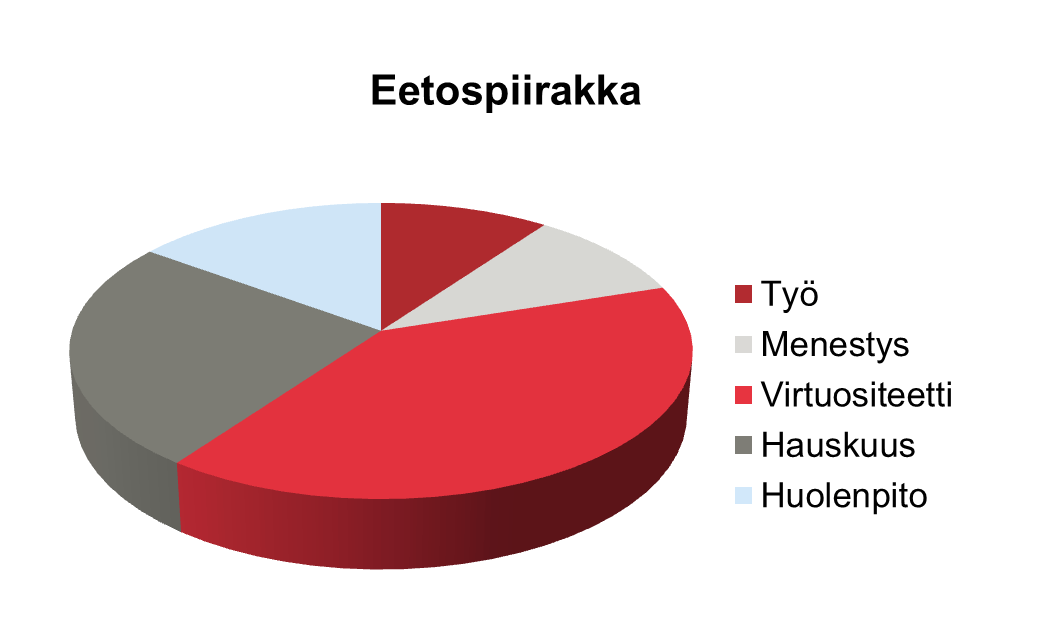
An optimal ethos model, is there such a thing?

What kind of pieces should the ethos of an optimal athlete - if such a thing exists now - consist of, if none of the ready-made models are perfect when fully realized?

The ethos of work includes the idea of the intrinsic value of work and suffering. Success has no meaning if it has not been achieved through uncompromising effort and endless drilling. Some parts of the work ethic are definitely needed. There are days, even longer periods, when training doesn't feel meaningful, or at least pleasant and fun. Then it's not a bad thing if the ethos of work makes the athlete turn to training, even if at that very moment they don't feel like winning the competition or showing anyone amazing performances. However, in its pure manifestation, the work ethic leads to illness more often than to the podium. So maybe this is not the main component?

The ethos of success is probably the most toxic when fully lived. In this ethos, everything stems from success. All. Up to human dignity. If only winning and being successful matter, such a person's moments of happiness are inevitably rare. The whole remains unhappy. Still, almost everyone who participates in some kind of competitive sport has traces of this ethos. I don't think there is much danger from these ribs, as long as they don't gain a significant foothold in a person's innermost being.

The ethos of virtuosity is morally easy to elevate and put on a pedestal as the single most viable ethos in the field of competitive sports. When a person is driven forward by virtuosity, the desire to perform superiorly, the focus of sports is not training or success, but performance. This is an excellent starting point. At that time, the forces driving this ethos forward may still run out, and there is no harm in a little help, for example, on the fronts of drilling or success.

The ethos of fun also sounds like a fundamentally viable model. When training and performing is fun, it is very easy to follow qualitatively and quantitatively high-quality training, which in turn leads to success. When competing at the top, success often requires, in addition to fun, the final touch of grimacing, which decides the final winners. If hedonism becomes the friend of the ethos of fun, and not, for example, the ethos of virtuosity or success, the victory in the final church struggle very easily turns to someone else.

The ethos of care focuses on community - training and competing in a circle of friends who care for each other. This ethos is undeniably good to be involved in individual sports as well, although in hindsight this is certainly emphasized in team sports. Even with my best will, I can't see a top athlete guided only by this ethos, even though it's probably clear that a fair dose of the ethos of caring is often not a bad thing.

Relationships and interaction of ethos blocks

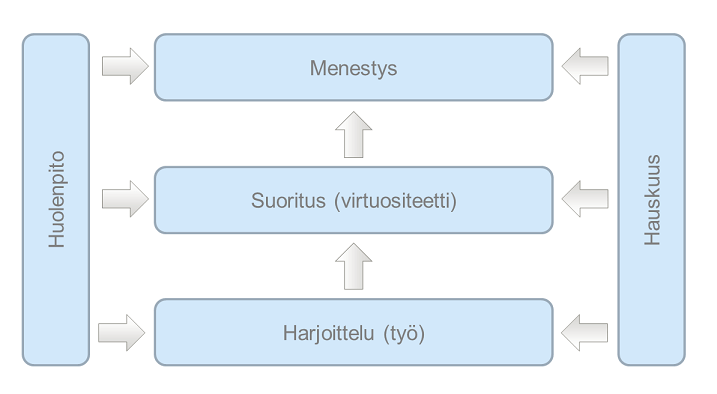
The flowchart of success in sports should accommodate an insane number of factors influencing the core and background, but as for these ethos blocks, I outlined the structure as follows. Underlying everything is practice (the work ethic), which leads to great performance (the virtuosity ethic), which leads to success (the success ethic). This stack is underpinned by the ethos of care and fun from its edges, which sort of return the threatening to fall off the edge of the stack back to the stack model that leads to success. In this model, the blocks can then be of different sizes according to different personalities.
This article was originally published on Teemu Heino's blog at HOJOMI.ES in the spring of 2016. A heavy thing never gets old!

Categories
front page Slider General

TU11 on Latvian taekwondo mats

As September turned into October, taekwondo G1 competitions were contested in Riga, the heart of the Baltic States. There was a long row of flags from different countries on the wall as an indication of the internationality of the player representation. Taekwondo athletes set off this time with the strength of four athletes. They fell on Saturdays Plum Duplicator, Severi Sarala and Jenna Partanen, Tuikku Holopainen on Sunday.

Severi and Plum are warming up for their taekwondo matches
Severi and Plum are warming up for their matches

Mr. Plum opened the game by taking on Italy's much taller Alexander Oberhofer in the cadet boys' under 49kg division. Plum put up a great fight, but the bigger Italian got the bad balance of Plum, who was well involved in the situation, thanks to his mass superiority, and was able to continue with the second kick too often by forcing the armor points through Plum's protection. The final result 3-17 tells mainly about the size difference between the boys, technically and tactically we were very involved in the match. Despite the loss, Plum gets a bronze medal.

Seuraavana nipin napin painoluokkansa (63 – 68 kg) alarajan rikkonut Severi koki saman kohtalon selkeästi isompaa liettualaista, Valciukas Mantvydasta, vastaan. Severi kokosi itsensä hienosti alun voimaerosta aiheutuneesti pienestä ”shokista” ja alkoi haastamaan kaveria toden teolla. Kahden erän jälkeen tilanne oli Liettualle 16-3. Viimeistä erää Severi lähti voittamaan ja saikin rakennettua ja hyödynnettyä muutaman hienon pistepaikan. Lopputulos 9-20 kertoi tässäkin otelussa lähinnä koko- ja voimaerosta.

Jenna and Teemu at a set break
Teemu Heino coaches Jenna Partas in the Latvian Open G1 competitions of Taekwondo

The third competitor of the day, Jenna, competed in her normal -67 kg category. Jenna, who had been ill the previous week, was a little unsure of her condition, but was able to perform well in her routine in her first match against Yana Piletskaya from Belarus and won the match 19-7. In the second match, the Karelian girl, Ekaterina Derbeneva, who in the end narrowly missed silver in the series, and who also enjoyed her time in Finland for a long time, came up against her. The match with Katja was evenly matched in terms of situations and general impression, but Katja's excellent protection kept Jenna's good kicks scoreless. Accordingly, Jenna's protection was bad in places this year, so the points of an apparently even match poured inconsolably into Katja's column. The points 1-12 left on the board tell in a harsh way the importance of protection and finishing in an otherwise even match, even though the coach, Teemu Heino, took the first point losses partly on his own. The selected starting pattern did not work as expected this time.

Tuikku aim for the top hit
We went to Sunday with the strength of one taekwondo athlete. Tuikku traveled Iiro Suorelan kiparoma's department on the way to Nurmijärvi, by the end of the pump the same journey, but with the rest of the TU team returning to Finland already on Sunday afternoon. Based on the last meeting in Poland, it had already been agreed in advance that Iiro would coach Tuikku as well, but due to overlapping matches, Teemu ended up sitting on Tuikku's bench, when the same Belarusian, Vitaliya Lazuta, who managed to beat Tuikku in Poland, also lined up against him. Like our other youngsters, Tuiku also had an opponent clearly bigger than him. Tuikku fought well, but failed to find a way to get close enough in the first two rounds. Many situations were like a repeat of Plum's match the day before. In the third set, Tuiku managed to lighten his number one hit in order to be able to make follow-up technique from a good balance close enough. This spawned one successful main and one armor hit, as well as a good amount of quality attempts that were only unreimbursed by bad luck. However, after a good third set, the final result is 13-5 for Belarus. Despite this, the bronze medal is still around Tuikku's neck due to the small series.

Overall, the club's performance was satisfactory in Kouts' eyes. In the statistics, two bronze medals and only one match win seems underwhelming, but because none of the lost matches were bad overall. There were many good elements in Jenna's lost match and the defeats of the youth division came after a hard fight against clearly bigger opponents. Sure, there were ingredients for much better things, but this was by no means a disaster of any kind. Heads up and through training towards new competitions!

Vielä loppuun tekee mieli mainitta hienosti toiminut seurayhteistyö Nurmijärven kanssa. Paitsi Tuikun matka- ja majoitusjärjestelyissä, oli yhdessä tekemisessä muutenkin paljon synergioita. Punnitukset, koutsaukset, liikkuminen ja ruokailujärjestelyt sujuivat paljon joustavammin yhdessä tehden kuin ”meidän seura kulkee omia reittejään” -meiningillä. Iso kiitos siis paitsi omalle retkueelle (kilpailjoiden lisäksi Katri Sarala and Sami Kopisto), also for the Nurmijärvi pump and Iiro.

Categories
front page Slider General

New dan values for taekwondo athletes

The examinees and the examiner after a successful dan exam

On Saturday, September 23, 2017, belt exams were held at the Taekwondo athletes' hall for the first four black belt tryouts and two who are increasing their dan rank. The seven-hour sweat job with ceremonies was crowned at eight in the evening, when the former red belts got the darkest belt on their hips. The whole group passed the belt exam with flying colours, and despite the occasional heavy fatigue, the faith in their own doing remained amazingly well in the end, even though the organizers of the belt exam, Teemu Heino and Juho Kostiainen, tried their best to challenge the test takers and sometimes even slightly open the door to disbelief.

It was gratifying to see how the trainees' understanding of technique, power output and fighting in its various forms has developed to a level that entitles them to a black belt. In both forms of competition, in the series of moves and in the match, the overall performance was strong. Of course, specialization in these forms of sports was visible in the tests in both directions, but on the other hand, it would be worrying if it was not visible. When the performances were good across the board even in the weakest part, you can be satisfied with the test also from the sports club's point of view.

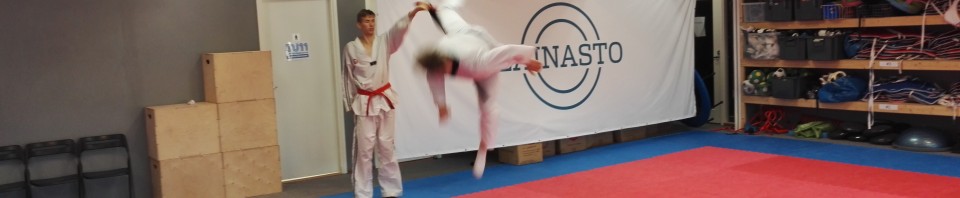
Jumping back spin kick. Christian Kamphuis
Christian's flying back spin kick was seen dozens of times during the test

It's always a celebration when more black belts are added to the club. Our club, now six years old, is in a situation where enthusiasts who have started with us are increasingly becoming aware of the value of a black belt, and the number of black belt test takers will probably increase in the coming years. Good luck with your new black belts! Remember that the road is just beginning!

On September 23, 2017, they successfully increased their belt value

  • Matti Sairanen, 3rd dan
  • Christian Kamphuis, 2nd dan
  • Severi Sarala, 1st dan
  • Enni Jaakkola, 1st dan
  • Sami Leskinen, 1st dan
  • Aleksi Väyrynen, 1st dan


Categories
front page General

The summit camp on Sunday, April 2, 2017

Multiple A-class / G-tournament winner, Cuban-born German, Alberto Celestrin arrives in Finland and as a guest of TU11. In order to take advantage of Alberto's quick visit, we will organize a match camp at TU11's Konala hall on the Sunday after the Nurmijärvi Games. There will be a couple of hard-level workouts for each training group.

Alberto Celestrin
Alberto Celestrin

Tentative schedule:

10:00 – 11:20 Children + Cadets (ages 7-14)
11:30 – 13:00 Trains + Adults (+15 years)
13:40 – 15:00 Children + Cadets (ages 7-14)
15:10 – 16:30 Trains + Adults (+15 years)

The division of groups can be modified if, based on those who registered in advance, the groups are of substantially different sizes. Those registered will be informed about the changes on this page, on FB and by e-mail immediately, if the need for changes surprises.

Pre-registration is not necessary, but if there are more visitors than the hall can accommodate, those who have registered will naturally have priority, Pre-registration by email: info@tu11.fi.

The price of the camp day is €30, on the spot in cash. The price includes hall accommodation Sat-Sun, if someone coming from further afield wants to stay directly from the Nurtsi Games.


You can't really overstate the advertising of this guy's skill, you should come and see for yourself!

http://www.taekwondodata.com/alberto-celestrin.aaxg.html


WELCOME FROM NEAR AND FAR!


Categories
front page Slider General

Black belt Jannet

Fresh black belts and the examiner after the belt exam

New taekwondo dans to Konala

20.12.2016 in the 1st dan exams held at the taekwondo athletes' gym successfully fought for their belts Jannet Wargelin and Trap. The roughly four-hour exam began Essi Labartin in connection with movement series training with warm-up and kicking technique, from which the test continued in a private lodge with basic technique and movement series. The basic techniques were quite comprehensively reviewed one by one, after which the technique was done while moving in the form. The basic technique was followed by the business series part. After that, the trainees were able to show their steering skills by pulling the warm-ups of adult enthusiasts' training, after which they moved on to the fast-paced step fight and self-defense section. During the small physical Huil, the written part of the exam was completed.

Three hours from the start of the test, we got to measure the mental and physical edge for the match technique part, the warm-ups of which were again handled by the belt coilers. Petteri Kauppinen oli tullut paikalle varta vasten pitämään huolen siitä, ettei kokelaiden otteluosuus olisi aivan piikittömillä ruusuilla tanssimista. Otteluosuudessa käytiin läpi niin old school kuin new age -tekniikkaakin ja lopuksi tietysti sparrattiin – vyökokelaat myös kaksi yhtä vastaan moodissa. Neljän tunnin jälkeen päästiin vielä taistelemaan väsymystä ja kramppeja vastaan hyppypotkuosuuteen, ja kokeen päätteeksi tehtiin vielä ”murskaukset”, jotka tällä kertaa olivat materiaalin puutteen vuoksi soveltavia, mutta osaamista ja voimantuottoa riittävällä tasolla mittaavia.

After the hall had already quieted down for the night, cramps were massaged, test feedback was given, a beautiful but manly barren belt ceremony was held, and the accompanying portrait was taken with a self-timer. The examiner congratulates the new black belts, Jan-Eric Wargelinia and Janne Ritaa, mahtavalla tsempillä läpi vedetystä dan-kokeesta. Osaamisen taso ylitti mustan vyön kriteerit kirkkaasti, vaikka muutamaan osa-alueeseen jäi vielä reilusti parannettavaakin. Toimenpiteet ”heikkouksien” korjaamiseksi käytiin alustavasti läpi ja seuraavassa kokeessa herroilta on lupa odottaa vielä entistä eheämpää kokonaisuutta ja jämäkämpää tekemistä.

The test was evaluated and the article was written by:
Teemu Heino

Categories
front page Newsletter

New yellow belts for Kalajärvi

Kalajärvi belt swimmers and Veeti and Onni, who participated outside the belt test, in a group photo

The Kalajärvi Synsy 2015 belt exam was held as part of Hannu Vikström's and Tanja Raivio's dan exams. Hannu and Tanja performed the task very well, as did the young beginning taekwondo athletes from Kalajärvi. The following belt ratings were successfully completed:

ANTOSHULSKAYA ANNA, 7. KUP
VALKAMA ANNI, 8. KUP
SEPPÄNEN SANNI, 8. KUP
KOTALA MILLA, 8. KUP
SUNDHOLM MILJA, 8. KUP
RUSILA JESSICA, 8. KUP

Categories
front page Slider General

New teacher values for taekwondo athletes

More teachers for TU11

On December 3, 2015, the values of the black belt were increased in the TU11 gym. Pauli Raivio and Hannu Vikström completed their 4th dan and are now TU11's newest teacher-worthy black belts. In the same exam, Tanja Raivio increased her belt rank to 2nd dan. The test started with the basic technique section, after which Hannu and Tanja held a yellow belt test for the Kalajärvi group as part of their own belt test performance. From Kalajärvi, we returned to the Konala gym for the wrestling part of the belt test, where sweat and contact were not spared.

Teemu Heino, the holder of the belt test, was very satisfied with the test takers' performance and hard work in the tests. Big thanks also to Petteri Kauppinen, who we will hear more about very soon, as well as Emilia Lahte and Jan-Erik Wargelin, who helped in the struggle part of the test.

Categories
General

Essille 3 dan black belt

Let's put on advanced black belts and examiners

On the last day of July 2015, the black belt test was held in the TU11 hall, where Taekwondo athletes increased their belt rank Essi Labart. Essi performed well in her test, and naturally excelled especially in the movement sequence part. After the exam, Essi's belt value is 3 dan.

A group of three people from Tampere from the Doboksport club, which is part of Teemu's teaching line, also participated in the test. A long-time national team player completed his third dan from Doboksport Saina Savage and actively working as a match referee Anna-Kaisa Lindfors. 2. Dan's belt completed Veikko Skurnik.

The belt test was held by the instructors of the Taekwondo athletes Teemu Heino (5 dan) and Juho Ranta (3 Dan).

Categories
General

Black belts for Mati and Lasse

In the belt exams held on Friday, June 26, 2015, Matti Puromäki and Lasse Laaksonen passed the six-hour long black belt exam with acceptable feedback. The Dan exam was given by Teemu Heino and Juho Ranta. Taekwondo athletes congratulate new black belts!

In connection with the black belt exam, eight kup values were also graduated for people who could not participate in the previous spring exams. Congratulations to them too for their successful performance!

dan-koe_26062015

kup-koe_26062015

Categories
General

Arpa favored visitors to the open house

Petteri directs the open-door presentation exercises

The taekwondo athletes' open day was visited by a good number of people interested in the new hobby. The program included sport introductions and trials, bun coffee and all kinds of sport-related and non-sport-related conversations. In the draw for free training months organized at the event, the lottery favored the following people, who each won one free training month at the Taekwondo athletes' gym.

  • Kasper Entchev
  • Katja Hytti
  • Mateusz Szura
  • Krystian Szura